
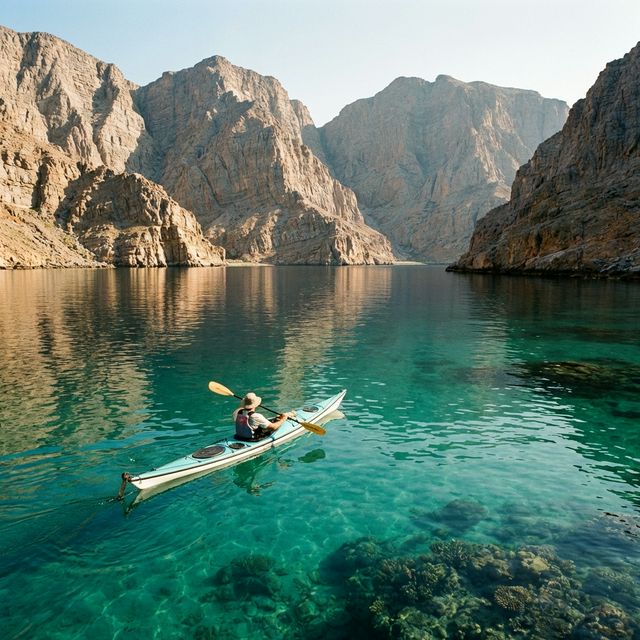
Musandam is a small, mountainous exclave at the tip of the Arabian Peninsula, separated from the rest of the Sultanate of Oman by a strip of the United Arab Emirates. It covers 1,800 square kilometres, rises to 2,087 metres at Jebel Harim, and is home to about 30,000 people — most of them concentrated in the three coastal towns of Khasab, Dibba, and Bukha.
A landscape carved by tectonics
The Musandam Peninsula sits on the collision zone between the Arabian and Eurasian tectonic plates. Over millions of years, the same forces that pushed up the Zagros Mountains in Iran and the Hajar Mountains in eastern Oman have fractured the limestone bedrock of Musandam into a series of parallel ridges and valleys. The sea flooded the lower valleys, creating the sheltered inlets called khors.
Khor Sham is the largest — a 16-kilometre fjord that cuts deep into the peninsula, with limestone walls rising 1,000 to 2,000 metres on either side. Khor Najd is the most remote, accessible only by 4x4. Khor Qanaha, Khor Maqlab, and Khor ash Shisas are smaller, with working fishing villages at their head.
History from the Bronze Age to the Portuguese
The khors have sheltered human settlement for at least 4,000 years. Bronze Age rock art is found in Wadi Khasab and the Sayh Plateau, and the granite outcrops of Jebel Harim carry the fossilised remains of ancient sea creatures — proof that the limestone was once a shallow sea bed. The Portuguese occupied Musandam from the early 1500s to 1650, building the Khasab Fort (1623) and the Bukha Fort to control the Strait of Hormuz and the trade routes to India and East Africa.
After the Portuguese were expelled, the Omani Yaruba dynasty took control, and Musandam has been part of Oman ever since. The 19th century brought the Kumzari fishermen from the Iranian coast, and their language — Kumzari — is still spoken by about 4,000 people in the coastal towns. The 20th century brought the British (Musandam was a protectorate under the 1891 exclusive agreement), the oil economy (the peninsula controls the Strait of Hormuz), and the 1970s unification of the UAE, which cut Musandam off from the rest of Oman.
The Kumzari community and the Omani traditions
The Kumzari people are the descendants of Iranian fishermen who settled in Musandam between the 10th and 14th centuries. They speak Kumzari — the only Iranian language on the Arabian Peninsula — and they are concentrated in the old quarters of Khasab, Dibba, and Bukha. The Kumzari language is one of the most endangered in the region: about 4,000 speakers, no written form, and no formal teaching.
The Omani traditions of Musandam follow the rest of the country but with distinct local features. The men wear the dishdasha and the kummah, the women wear the colourful embroidered abaya, and the Friday Jumu'ah prayer fills the Al-Hammadi Mosque above the port. The fishing boats leave the port at 04:00 and return at 10:00. The fish market sells the catch from 06:00 to 13:00. The corniche fills with families from 17:00 to 20:00. The day ends with chai, Arabic coffee, and shisha at Oman House Cafe.
The geography and the climate
Musandam has two seasons: the cool, dry winter (October to April, 18–30°C) and the hot, humid summer (May to September, 32–42°C). The khareef mists come in from the Indian Ocean in late June and clear in early October. The sea temperature ranges from 22°C in winter to 33°C in late summer. The visibility at the snorkel sites is 8–12 m in winter and 15–25 m in summer.
The strait between Musandam and Iran is only 39 km wide at its narrowest point. The Strait of Hormuz — through which 20% of the world's oil passes — is the strategic centre of the region. The military checkpoints on the mountain road are part of the border security around the strait; tourists are asked not to photograph the checkpoints or the soldiers.
Our operator story — Book Musandam, 2013 to 2026
Book Musandam Tours & Travels was founded in 2013 by Captain Salim Al-Busaidi, a second-generation dhow captain from Khasab. The first dhow was Al-Salam, a 22-metre traditional Omani dhow built in 2018. The first office was a 20-square-metre room above a tea shop on the corniche. The first season hosted 220 guests.
Twelve years later, we run 4 dhows (Al-Salam, Al-Khaleej, Al-Marwa, Al-Badiya), 2 speedboats (Sea Hawk 1, Sea Hawk 2), and 3 4x4s (2 Land Cruisers, 1 Patrol). Our team is 14 people, including 4 captains, 3 mountain drivers, 4 deckhands, 2 office staff, and 1 mechanic. We have hosted 12,400+ guests from 60+ countries. We are rated 4.9/5 across 847 verified reviews. Our office is now on Port Road, opposite Lulu Hypermarket, second floor.
We are licensed by the Oman Ministry of Tourism (license number MOT/2013/0284) and insured by Oman United Insurance. We are members of the Oman Society for Tourism and the Khasab Chamber of Commerce. We are not a marketplace, we are not a reseller — every booking is handled by our office in Khasab, every dhow cruise is captained by our captains, every mountain safari is driven by our drivers.